
Important differences between key switches and general switches
Release time:
2022-10-24
The key switch is a combination switch that can be multi-pole and multi-name with Lego building blocks. The key switches are basically multi-gear combination type, and some people use single gear (common switch power switch). In addition to the number of blocks and poles of the switch, the key switch also has different locking methods. The locking methods are divided into three types: locking, self-locking and interlocking, and no locking.
The important difference between the key switch and the general key switch is:
① It should be used in the form of function keys to access or break one or more sets of household appliances contacts, rather than by turning the dial up and down or back and forth;
It is generally mostly a combination of linkage structure, not just a single switch like a general switch;
③ The linkage contacts on each switch are more than one set of "multi-pole" switches, rather than only one or two contacts;
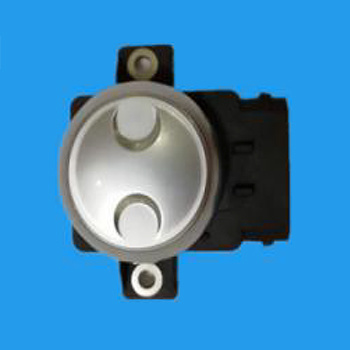
④ When pressing all of the multiple switches, all the original switches will be calibrated to the original state (except for locked and unlocked structures);
⑤ There are self-locking interlocking, locking and lock-free use of three kinds of structure for customers to choose, very practical and convenient.
the basic principle of the key switch:
Long strip shape, there are generally six welding points, double pole and double throw, two welding points in the middle are the key-in ends, and four welding points on both sides are the output ends. Including 2 groups of separate array double throw switches and 2 groups of synchronized postures. After pushing, the middle keying end and the distal welding point are turned on and off, and pushing again will rebound back, and the middle keying end and the proximal welding point are turned on and off.
It is mainly composed of three parts: function key components, double rocker mechanism and contact switch group. Each of the function key parts includes a function key, a key lever, a function key rectangular spring, and the like. There is a protruding load-bearing beam in the middle area of the key rod, which presses a trapezoidal insulating layer block, while one end of it presses the slope of the sliding convex rod, and the lower edge of the key rod is sucked on the rectangular spring. When a certain block function key is pressed, the key lever pushes the ladder-shaped insulating layer block to sink, and the insulating layer block promotes the contact switch reed on the side to close it.
The double rocker organization is composed of double rocker, double rocker rectangular spring, gear lock block, etc. There is a tenon at each key lever, which has a slope on the upper side and a concave groove on the lower side. The bearing beam of the key rod presses the slope. When the key rod sinks, the bearing beam presses the slope tightly, causing the double rocker to move sideways. When the bearing beam is moved to fall into the concave groove of the tenon, under the influence of the double rocker rectangular spring, the double rocker is calibrated, and the tenon locks the key rod, thus keeping the contact closed. At this time, if the second function key is pressed and pressed, its bearing beam will promote the side movement of the double rocker, the function keys will bounce up under the influence of the rectangular spring of the key
Related News
Copyright©Yueqing Niufulai Electronics Co., Ltd www.300.cn SEO
Contact Us

Address: Tiancheng Industrial Zone, Yueqing City, Zhejiang Province
Telephone:+86-577-61367666
Mobile:+8617336225855
E-mail:sales@niufulai.com